Bedding · Sleep environment
Vispring Bedding Layers: Balancing Protection and Breathability
A mattress protector has a quiet assignment: take the minor troubles of daily life—the spill, the perspiration, the dust, the ordinary passage of time—without making the bed feel like it has been wrapped for storage. The most useful layers protect the surface while leaving its comfort, temperature, and character largely intact.
Published November 23, 2026
There is a particular pleasure in getting into a well-made bed. The sheet is cool; the mattress gives way by just enough; the layers above it feel present but not conspicuous. A protective pad is at its best when it contributes to this impression of ease without announcing itself. It should stand between the sleeper and the mattress, but not between the sleeper and a good night’s rest.
That modest brief involves a number of decisions. A cover’s fabric affects the sensation against the body. Its fill may introduce a little cushioning or warmth. Its skirt and pocket depth determine whether it stays put. And its washing instructions matter, because a protector that is awkward to clean can become a protector that is not cleaned. With bedding, as with other household objects, practicality is not a lesser virtue. It is one of the conditions of comfort.
Vispring’s cotton-and-wool protective layer offers a useful example. The Vispring Lux Skirted Mattress Protector has a cotton outer, British wool filling, a fitted style, and a fully elasticated skirt. The stated pocket depth is 13.75 inches. Those details describe not simply a material palette but a set of everyday choices: how much loft to expect, how the pad may sit on a mattress, and what kind of care it asks of its owner.
Protection that does not take over
A mattress is a substantial object, in both the literal and the domestic sense. It is used night after night, and replacing it can be inconvenient as well as costly. A washable protective layer can help limit contact with body oils, perspiration, dust, and the occasional spill. It may also make routine upkeep simpler: rather than attempting to clean the mattress itself, a household can remove and launder the layer that has been designed to come off.
Protection, however, is not synonymous with complete waterproofing. A fabric pad can offer a washable barrier against ordinary wear without necessarily providing the sealed defense of a waterproof protector. The distinction matters. Someone trying to guard against frequent spills or nighttime accidents should check the product’s specifications carefully rather than infer waterproof performance from the word “protector.” For a bed that needs a moisture barrier, the construction and care label should make that feature explicit.
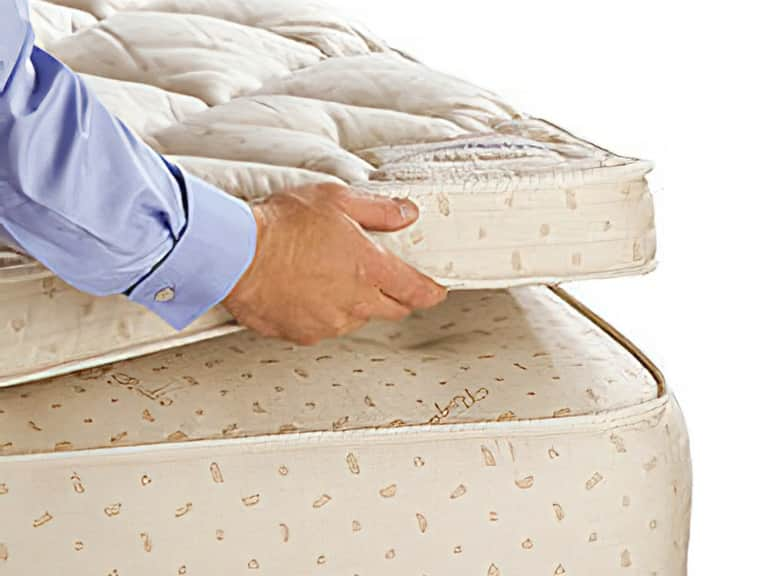
The Vispring Lux pad is described as a softly quilted, breathable layer, with cotton on the outside and British wool inside. Its role is to add a washable layer over the mattress, not to change the mattress into another model. That is a useful way to think about protective bedding: it can help preserve a sleep surface and make it a little more comfortable, but it should not be expected to correct a mattress that no longer offers suitable support.
Before choosing any protector, consider the problem it is meant to solve. Is the priority reducing exposure to spills? Keeping the sleep surface easier to launder? Adding a small amount of softness? Managing warmth and moisture? A single layer may address some of these aims more effectively than others. Clarity about the household’s actual needs prevents an appealing material description from standing in for a feature the product does not provide.
Cotton and wool: different work, shared bed
Cotton is familiar for good reason. It is used in sheets, covers, and many other bed textiles because it can feel soft and breathable, and because it is generally straightforward to understand as a fabric. In a mattress pad, the cotton outer forms the surface and casing around the fill. The hand of that surface, its quilting, and the way it is finished all affect how the layer feels under a fitted sheet.
Wool brings a different set of qualities. Its fibers can absorb moisture vapor and help buffer changes in warmth, which is one reason wool appears in bedding intended for varied seasons. A wool-filled pad may feel gently cushioned while avoiding the dense, sealed sensation some sleepers associate with heavier synthetic layers. These characteristics are not guarantees that every person will sleep cooler or warmer; bedding interacts with the sleeper, the room, the mattress, and the rest of the bed’s layers. Still, wool’s capacity to manage moisture and temperature is part of its appeal.
In the Vispring protector, cotton and wool are paired rather than asked to perform the same task. The cotton cover supplies the fabric exterior; the British wool fill contributes loft and natural insulation. The pad’s quilting helps keep the filling in place and creates the soft, gently structured surface that distinguishes it from a thin fitted sheet or a taut barrier. The result is a layer with some presence, though not necessarily the dramatic change in feel associated with a thick topper.
That difference between a pad and a topper is worth keeping in view. A mattress pad is primarily a protective and modestly cushioning layer. A thick topper is intended to alter the feel of the bed more substantially. Adding a generous amount of cushioning may change how the body settles, and it can make sheets harder to fit. If the goal is to preserve a mattress’s original feel, a relatively restrained protective layer is often the more natural starting point.
The art of fit
A protector can have admirable materials and still be a poor match if it slips, bunches, or strains at the corners. Fit is not a decorative detail; it determines whether the layer behaves like part of the bed or like a loose object that must be corrected every morning. A fitted skirt can help hold a pad in place, while elastic around the edge gives it some capacity to accommodate movement and a range of mattress dimensions.
Start with the mattress’s width, length, and depth. Then consider anything already on top of it. A pillow-top mattress or a separate topper adds height, and the total can exceed the mattress depth alone. The Vispring Lux protector specifies a 13.75-inch pocket. That measurement is a useful reference, but shoppers should compare it with the actual assembled height of their bed and confirm how the product is intended to fit. A pocket that is too shallow may pull away from the corners; one that is much too deep can leave excess fabric beneath the mattress.
There is also the question of how secure a layer needs to be. A full elasticated skirt encircles the mattress and can provide a more continuous hold than corner straps. Straps may be easier to remove, but they can shift, especially if the mattress is tall or the bed is frequently adjusted. Neither approach is universally superior. The best fit is the one that suits the mattress dimensions and the household’s habits.
These small checks can save a great deal of nightly irritation. If the bed has an adjustable base, verify compatibility rather than assuming that a fitted protector will remain smooth when the frame moves. If the mattress is unusually deep, check whether the maker offers guidance. If a new layer changes the way the fitted sheet sits, account for its added height when choosing sheets. The bed is a system of layers; each one affects the fit of the next.
A layer is also a care routine
Washability is one of the most practical specifications on any bedding label, but it is not a single, universal promise. A cotton cover may be easy to launder while a natural fill calls for gentler treatment. Quilting, elastic, and the size of the pad all influence how convenient it is to wash and dry. A queen or king protector may fit into a household washer, or it may not; the instructions, rather than optimism, should decide.
For the Vispring Lux protector, the stated care guidance is to wash monthly on a gentle cycle in cold water with like colors and a natural detergent. The instructions advise against whiteners or bleach, recommend line drying or low tumble drying, and say to remove the item promptly. Fabric softeners and dryer sheets are not advised because they can reduce cotton’s absorbency. These details are not incidental. They describe the conditions under which the materials are meant to be maintained.
Before washing, check the complete care label and the current manufacturer’s instructions. Take into account the size of the machine and allow the layer to dry fully before returning it to the bed. A damp or incompletely dried pad has no place under freshly made sheets. For households that prefer infrequent laundering, a washable protector may still be useful, but its maintenance schedule should be realistic. The most effective bedding routine is one people can actually follow.
It can help to make care part of the decision rather than a discovery made later. A washable cotton-and-wool pad may appeal to someone willing to handle a gentle cycle and careful drying. Someone who wants frequent hot washing or tumble drying should check whether those conditions are suitable before buying. Natural fibers are not inherently difficult, but their care requirements can be more specific than those of some synthetic alternatives.
When a natural layer makes sense
There is no single bedding material that is right for every sleeper. Temperature preference, skin sensitivity, laundry habits, climate, mattress construction, and the feel of the existing bed all matter. A wool-filled layer may be worth considering for a sleeper interested in natural fibers and a softly cushioned surface. A cotton cover may appeal to someone who prefers a familiar, breathable textile. Neither material can substitute for an individual assessment of comfort.
It is sensible to be precise about claims. “Natural” does not mean that a product is suitable for every allergy or sensitivity, and a fiber’s general properties do not establish that a specific item will resolve a health concern. People with significant allergies, asthma, or skin conditions may wish to review product information carefully and consult a qualified health professional about relevant triggers. Likewise, a pad’s material does not determine whether a mattress is appropriate for a particular medical need.
For a bed whose feel is already comfortable, a thin or moderately lofted protector can preserve that familiar experience. For a mattress that feels too firm, a pad with modest cushioning might soften the surface slightly, though a protector is not a substitute for a purpose-built topper. If a mattress feels unsupportive or has developed a lasting sag, adding layers may disguise the problem rather than solve it. A protective layer can maintain a bed; it cannot restore the structure beneath it.
A closer look at the Vispring Lux protector
The Vispring Lux Skirted Mattress Protector is specified with a cotton outer, British wool filling, a fitted style, and a pocket depth of 13.75 inches. Its quilted construction is intended to provide a softly cushioned protective layer, while the elasticated skirt helps secure it around the mattress. The product’s care guidance calls for gentle washing and low-impact drying rather than bleach, fabric softener, or dryer sheets.
Those features make it a considered option for someone who wants a natural-fiber layer with a fitted design and is comfortable following a careful wash routine. The wool filling may provide more body than a plain, thin protector, so anyone seeking no change at all in the bed’s surface should think about whether that additional loft is welcome. And because the stated pocket depth is not a universal fit, measuring the mattress and any topper remains essential.
The name “Vispring” should not distract from the ordinary questions that make a product suitable or unsuitable: Does it fit? Does it do the kind of protection required? Can it be cared for in the household’s usual way? Does the resulting surface feel pleasant? Brand associations and material descriptions may prompt interest, but the measurements and care instructions are what turn interest into a practical decision.
A short checklist before choosing
Before adding a protective layer, take a moment to inspect the bed and the routine around it. A checklist can keep the decision grounded in use rather than in adjectives.
- Measure the full bed height. Include a pillow top or topper, not just the mattress core, and compare the result with the stated pocket depth.
- Define the kind of protection needed. A quilted pad may help with everyday wear, but do not assume it is waterproof unless the maker says so.
- Consider the surface feel. Cotton and wool can add a little cushioning and warmth; decide whether that change suits the mattress.
- Read the care instructions. Confirm washing temperature, detergent guidance, drying method, and any restrictions before purchase.
- Think about the rest of the bedding. Added loft may affect fitted-sheet depth and how the bed feels as a whole.
- Choose for the people who use the bed. Their comfort, sensitivities, and laundry routine matter more than a generalized claim about what all sleepers should prefer.
Comfort is often an arrangement
People tend to speak of a mattress as though it were a single object. In practice, the sleep surface is assembled: mattress, protector, pad or topper, fitted sheet, and sometimes another light layer. Each piece contributes something, and each can interfere with the others if chosen without attention to fit and care. The result may be a bed that feels inviting, or one that slides, traps heat, or requires more maintenance than anyone anticipated.
A breathable protective layer is not a miracle of sleep, and a wool fill is not a promise of a particular night. The value is quieter. A suitable pad can take everyday contact, offer a little softness, and make the mattress easier to maintain. Cotton and wool are one way to pursue that balance: familiar fabric outside, moisture-managing natural fill within, and construction intended to keep the layer in place.
The best choice is therefore less a question of luxury than of proportion. How much protection is useful? How much cushioning is welcome? How often will the pad be washed, and how will it be dried? A well-chosen layer answers these questions without making the bed feel like a collection of solutions in search of a problem. It protects discreetly, breathes as comfortably as its construction allows, and lets the mattress remain the principal character.